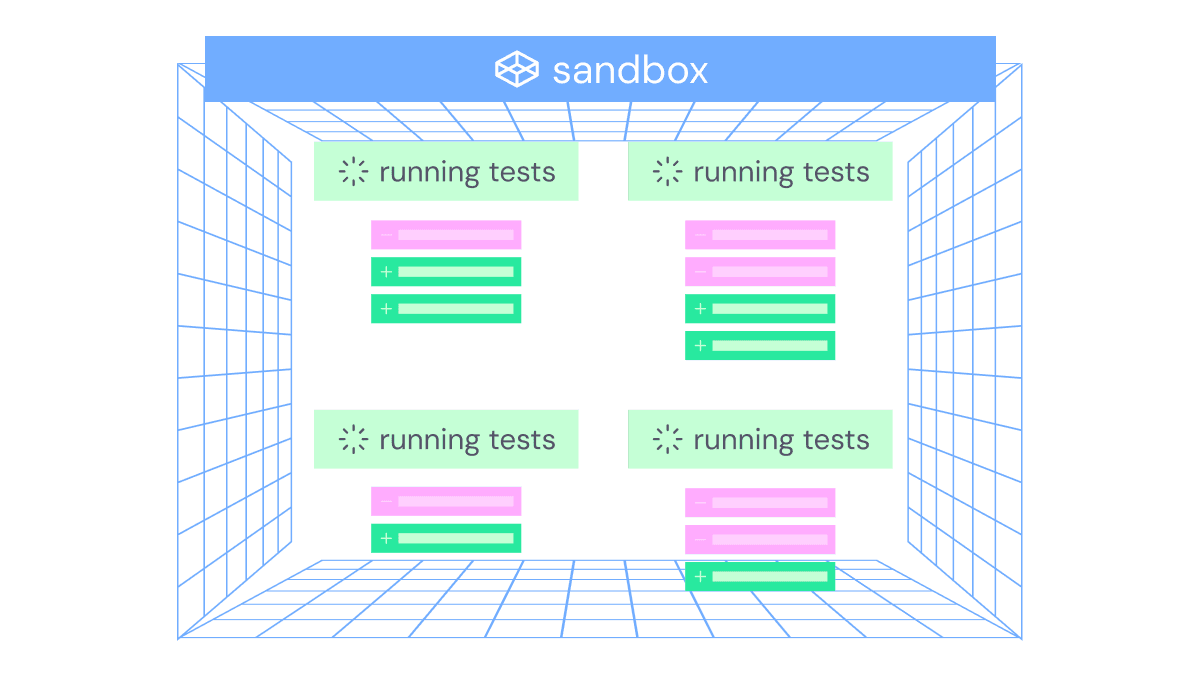
“As code velocity increases, code review becomes the bottleneck. Teams risk bad code reaching production, creating security issues or new bugs. The solution is AI code reviews.
”
AI code review tools like Greptile act as a line of defense against bugs in production. Read on to learn how AI code review works, and why top teams use it to maintain high-quality standards.
What is AI Code Review?
AI code reviews improve the traditional pull request (PR) process by automatically analyzing changes, identifying potential bugs or security issues, and providing context-aware feedback before human reviewers step in.
In most modern software teams, engineers review each other's code as a PR before merging into the main codebase, ensuring changes meet standards and don't introduce problems. This peer review process helps catch bugs, maintain consistent practices, and preserve overall code quality.
As velocity rises, engineers are more likely to miss nuances and PRs stack up. That slows merges and can introduce bugs when teams cut corners to clear the bottleneck.
AI code review improves this by evaluating changes the moment a PR opens. Benefits go beyond obvious mistakes:
- Catch bugs humans miss. Identify logic errors, syntax issues, and regressions before code reaches production.
- Improve security. Detect vulnerabilities (e.g., SQL injection, SSRF, unsafe input handling) as soon as they appear.
- Enforce consistency. Maintain team-wide standards without relying on memory or attention.
- Speed up delivery. Reduce back-and-forth so changes merge faster.
Unlike simple linters or static analysis tools, AI reviewers analyze code in context, provide clear, human-readable comments, and generate concise PR summaries. Tools like Greptile also learn over time, taking in manual feedback and enforcing custom rule sets the team uploads.
Why AI-Generated Code Is Harder to Review
When a human writes a bug, it's usually because they were tired, rushed, or didn't know about an edge case. The code often looks a little off. A quick scan of the diff and something feels wrong.
AI-generated code doesn't work that way. It's syntactically clean, well-structured, and reads like it was written by someone who knows what they're doing. The bugs it introduces are different: a function that handles 95% of cases perfectly but silently drops the other 5%. A retry loop that wraps another retry loop, turning 5 attempts into 25. An authentication check that looks correct in the file it's in but doesn't match how every other endpoint in the codebase does it.
The failure mode isn't sloppiness. It's confidence. The code looks right, which means reviewers are more likely to skim it. And the bugs tend to be cross-file logic issues, the kind you only catch if you understand how the change interacts with the rest of the codebase, not just the diff in front of you.
This shows up in our data. Across 17 million issues Greptile has flagged since March 2026, more than half were real defects in how the code behaves, not style or quality feedback.
| Severity | % of Flagged Issues | What It Catches |
|---|---|---|
| Critical (P0) | 1% | Security exploits, data loss or corruption, severe crashes |
| Defect (P1) | 52% | Wrong data, race conditions, broken contracts, incorrect behavior |
| Quality (P2) | 47% | Style, naming, readability, missing tests, dead code |
The bugs AI introduces aren't the kind a linter would catch. They're the kind that require reading the rest of the codebase to even recognize as bugs.
How Do AI Code Reviews Work?
The feedback left by AI code reviewers lives directly in platforms like GitHub and GitLab, so they integrate into existing workflows. A Greptile AI pull request review includes:
- PR summaries: An overview of what the pull request changes.
- Inline comments: Precise, line-level suggestions tied to the diff for fast fixes.
- Sequence diagrams: Auto-generated call flows so reviewers see "who calls what, in what order" at a glance.
- Context-aware suggestions: Analyze related files, APIs, configs, tests, docs, and history to understand intent—not just the diff. Context is critical because it surfaces hidden bugs early and keeps team standards consistent.
- Beyond-the-diff checks with iterative passes: Flag cross-layer issues (frontend/backend defaults, auth, env, deployment prerequisites), rescan after updates, and deliver an impact-ranked summary.
Greptile also lets developers tag the AI in a comment to ask follow-up questions or request clarification. By automating early review steps, AI reduces time to merge and lets human reviewers focus on higher-level feedback, the kind of structural and narrative questions captured in our code review checklist.
Confidence Scores for PR Triage
If every PR gets a wall of AI-generated comments, you'll ignore all of them within a week. The most useful thing an AI code review tool can do isn't just flag issues. It's tell you how much attention a PR actually needs.
This is what confidence scores do. Instead of treating every pull request as equal, a score tells you: this PR is clean, merge it. Or: this one has problems, spend your time here.
A config file rename doesn't need the same scrutiny as a payments refactor. A well-tested utility function doesn't need the same review as a new auth flow. Confidence scores encode that difference so you can allocate review time where it actually matters. For engineering leads managing a team's PR queue, this is the practical shift: scan scores across open PRs and you immediately know which ones need a human reviewer's full attention and which ones have already been thoroughly validated.
In our Q3 2026 data, the difference in outcomes between high and low confidence PRs is clear:
| Confidence Score | % of PRs | Median Time to Merge | Action |
|---|---|---|---|
| 4-5 (safe) | 83% | 1.3 hrs | Merge after minor fixes or immediately |
| 1-3 (needs attention) | 17% | 3.0 hrs | Address feedback, rework, or rethink |
That's a 2.3x difference in merge speed, and it tracks rework: 57% of PRs that started at 1-3 reached 4-5 after fixes. This isn't about skipping review. It's about spending review time on the right things.
AI Code Review Example
Here's an example of code review in action →

This large PR added multi-workspace support with subdomain management and lets teams pick auth providers per workspace. It touched frontend state, GraphQL, server env and docs, and auth flows.
Greptile reviewed it twice as the scope evolved. The first pass surfaced integration risks that would cause subtle breakage; the second pass rescanned the expanded diff and summarized new cross-layer changes so reviewers could focus on what mattered most.
First pass, it caught:
- A naming inconsistency in the flag (isMultiworkspaceEnabled vs isMultiWorkspaceEnabled) that would break lookups across files. The project followed with a fix commit to align the casing.
- A default mismatch: the frontend treated the flag as true while the server defaulted to false, which would gate features inconsistently. A human reviewer echoed this, validating the risk.
- Removal of the prior signUpDisabled state without a clear replacement, putting registration paths at risk.
- An operational prerequisite buried in docs: wildcard subdomains are required to run multi-workspace.
- Confirmation that server logic blocks extra workspace creation when the feature is off, so gating happens beyond the UI.
After fixes and a broader update, Greptile ran a second pass and flagged:
- Subdomain support wired into the workspace entity with uniqueness and auth-provider flags, and urged careful testing of subdomain behavior.
- A new DomainManagerService that centralizes URL and subdomain handling across the app.
- An auth flow refactor so the frontend respects workspace-specific providers and subdomain-based routing, plus server-side validation utilities.
- Env config split from a single FRONT_BASE_URL to FRONT_DOMAIN / FRONT_PROTOCOL / FRONT_PORT to improve deployability.
- Concrete breakage risks: removing the JWT generation mutation without a clear replacement and a subdomain query that lacked a parameter—both could fail at runtime.
Why did this matter, and why did Greptile surface it? These are cross-layer mismatches and flow regressions that linters and type checks rarely catch—and that humans struggle to spot quickly in a 160-plus-file PR. Greptile connected UI flags, server defaults, GraphQL, and docs in one review, then re-summarized after major changes so issues didn't slip through before merge.
Bottom line: Greptile prevented silent user-facing bugs and deployment foot-guns by doing end-to-end reasoning over a large, fast-moving PR.
More Real Catches in Production
The best way to evaluate any AI code review tool is to look at what it actually catches. Not style nits or formatting suggestions. Real bugs that made it through human review in production codebases.
Nested retry loop. A new method wrapped an HTTP request in a 5-iteration retry loop. But the method it called already retries 5 times internally. A single connection failure triggered 25 attempts with compounded exponential backoff. What should fail in 30 seconds could hang for minutes. The code read fine. You had to know the internals of the called method to see the problem. Netflix Metaflow - PR #2817
Reasoning traces leak into user responses. Internal AI reasoning traces were bleeding into user-facing responses across conversation turns. In a safety-critical guardrails system, users were seeing raw chain-of-thought output that was never meant to leave the server. NVIDIA NeMo Guardrails - PR #1468
Three conflicting reward implementations. The README, the evaluator, and the environment each computed rewards differently. Dead code in one file was silently overridden by another. No single file looked wrong. You had to read all three to see they disagreed. Meta PyTorch - PR #308
None of these are obscure. They're the kind of bugs that experienced developers would catch if they had unlimited time and full context of every file in the codebase. Across more than 16,000 open source repos, we've flagged over 1.6 million issues like these. See more real examples. The value of an AI code review developer tool isn't that it's smarter. It's that it reads everything, every time, without fatigue.
A Buyer's Guide to AI Code Review
With the basics covered, the next step is choosing how to evaluate an AI code review tool. Buyers weigh build vs. buy, the features that matter, and, ultimately, how a tool catches more bugs while fitting your workflow.
Keep Generation and Review Separate
Teams often ask if one product can both generate code and review it. It shouldn't. Creation and evaluation are different jobs, and the reviewer works best when it is independent. We separated auditing from accounting decades ago for exactly this reason.
Independence guards against two risks: shared assumptions that miss the same issues, and incentives that make a reviewer go easier on its own agent's output. An independent reviewer gives you a clean check before merge.
At today's velocity, more code is agent‑written and never read pre‑commit. Agents fail in novel ways: invented APIs, stray imports, hard‑coded values, and edits outside the intended files. The reliable place to catch that is the pull request.
The scale of the problem is real. In Q3 2026 alone:
| Metric | Value |
|---|---|
| PRs reviewed | 4.8M |
| PRs with at least one issue flagged | 65% |
| Median comments per flagged PR | 2 |
| Comments that led to a code change | 61% |
Most PRs have something worth catching, and most of it gets missed without an independent set of eyes.
A review‑only tool should run on every PR, look beyond the diff to related files and configs, rescan after updates, and rank issues by impact. It should learn your rules, surface security and integration risks early, and not write code.
Benefits & Limitations of a Dedicated AI Code Review Tool

In practice, here's what AI code review delivers today—and the limits you should plan around.
Benefits (what you should actually expect):
- Lower time to merge. Early, automated comments cut back-and-forth and let human reviewers focus on design decisions, not nits. Greptile speeds up merge time from ~20 hours to 1.8 hours.
- Fewer production bugs. Good systems catch cross-layer issues (defaults, auth, config, env) that slip past linters and type checks.
- Consistent standards. Enforces naming, patterns, and team rules, and continuously learns over time.
- Security surfaced earlier. Flags obvious injection/unsafe handling in the PR, not in a post-deploy scan.
- Better reviewer focus. PR summaries and impact-ranked findings help triage large diffs fast. (Greptile also adds sequence diagrams for "who calls what, in what order.")
Limitations (plan around these):
- Noise exists. False positives and overbroad suggestions happen; Greptile includes severity thresholds and other settings so you can manage the signal-to-noise ratio.
- Confidence scores are a triage tool, not a rubber stamp. A high score means the reviewer found nothing concerning. It doesn't mean nothing is wrong. Use scores to decide where to invest your time, not to skip review entirely. When most PRs don't receive human comments, having a reliable signal for which ones should matters more than ever.
- Coverage and context are uneven. Most tools offer generic suggestions. Greptile indexes your entire codebase, so feedback is tailored to your code.
- Stochasticity. Models are sampling-based, so the same PR can get different comments and one pass can miss edge cases or cross-file bugs. Greptile counters this by grounding reviews in a full repository index for steadier, repeatable results.
- Self-hosting / security. Many tools can't be self-hosted, so code and secrets leave your network. Greptile supports self-hosting in your VPC, keeping data local and under your keys.
Conclusion
As shipping speed climbs, the real win is keeping quality high without slowing teams down. AI code review turns PRs into fast, high-signal checkpoints so you can merge with confidence at your pace. Try Greptile today.